
Moving drainage gaps
Ring movement helps keep the drainage surface open.


Dewater continuously with a multi-disc screw press. Reduce the volume you store, transport and send for disposal with compact equipment designed for automated operation.
Sludge cost includes the cost of the water it carries.
The press combines thickening and dewatering in one cylinder. A screw conveys sludge as liquid drains between fixed and moving rings; compression at the outlet forms a cake that is easier to handle.
Ring movement helps keep the drainage surface open.

Feed, polymer, wash water and discharge can follow one automatic sequence.

Slow rotation and cylinder washing matched to the operating duty.
Cylinder access and wear-protection selection based on the sludge.

Thickening and compression combined in a single process unit.
Handles sludge from biological or physicochemical treatment, including precipitated phosphorus.
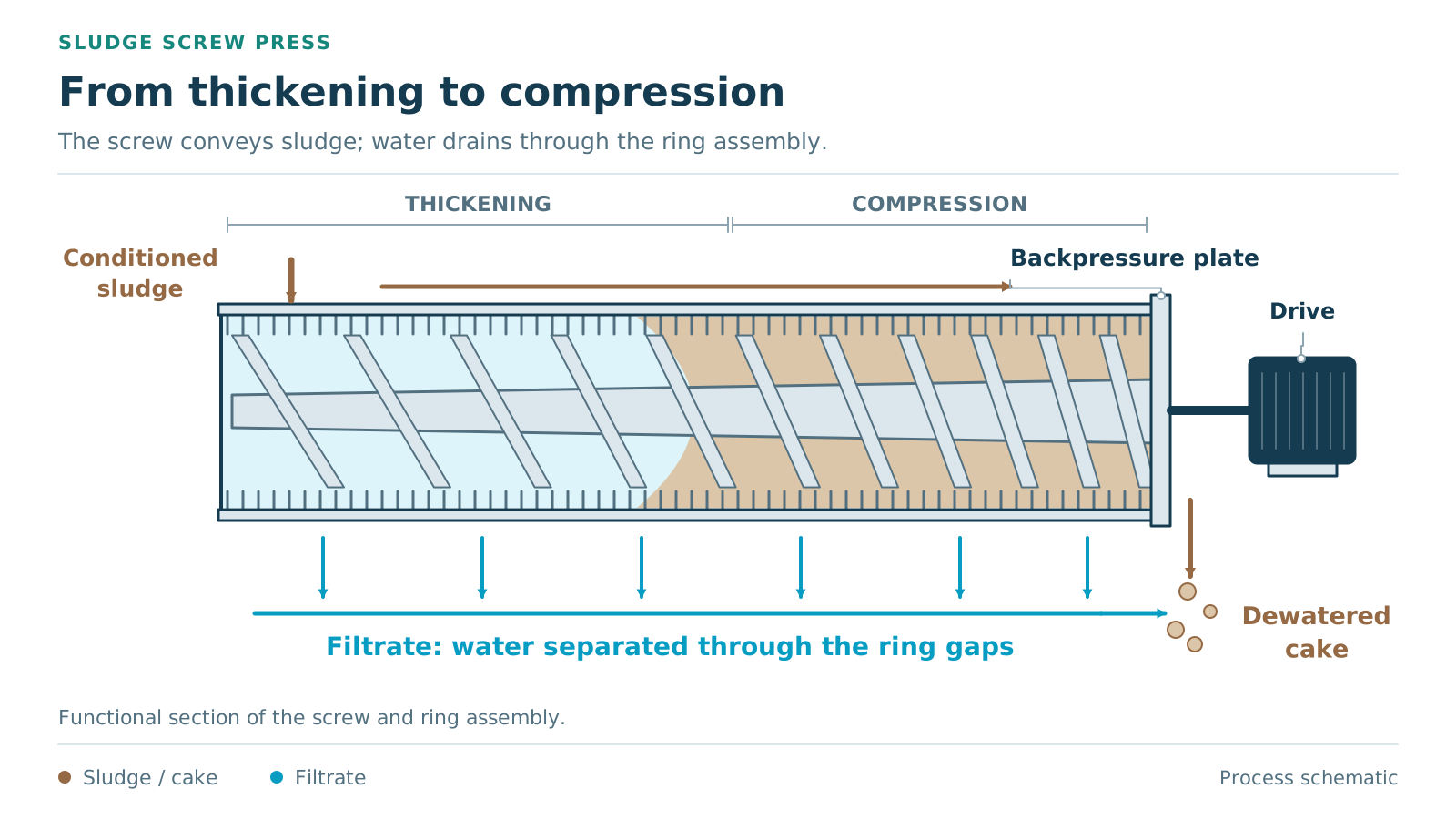
Conditioned sludge enters the cylinder and releases readily drainable water.
Screw geometry and back pressure progressively increase dewatering.
Cake leaves the end of the cylinder and filtrate is collected separately.
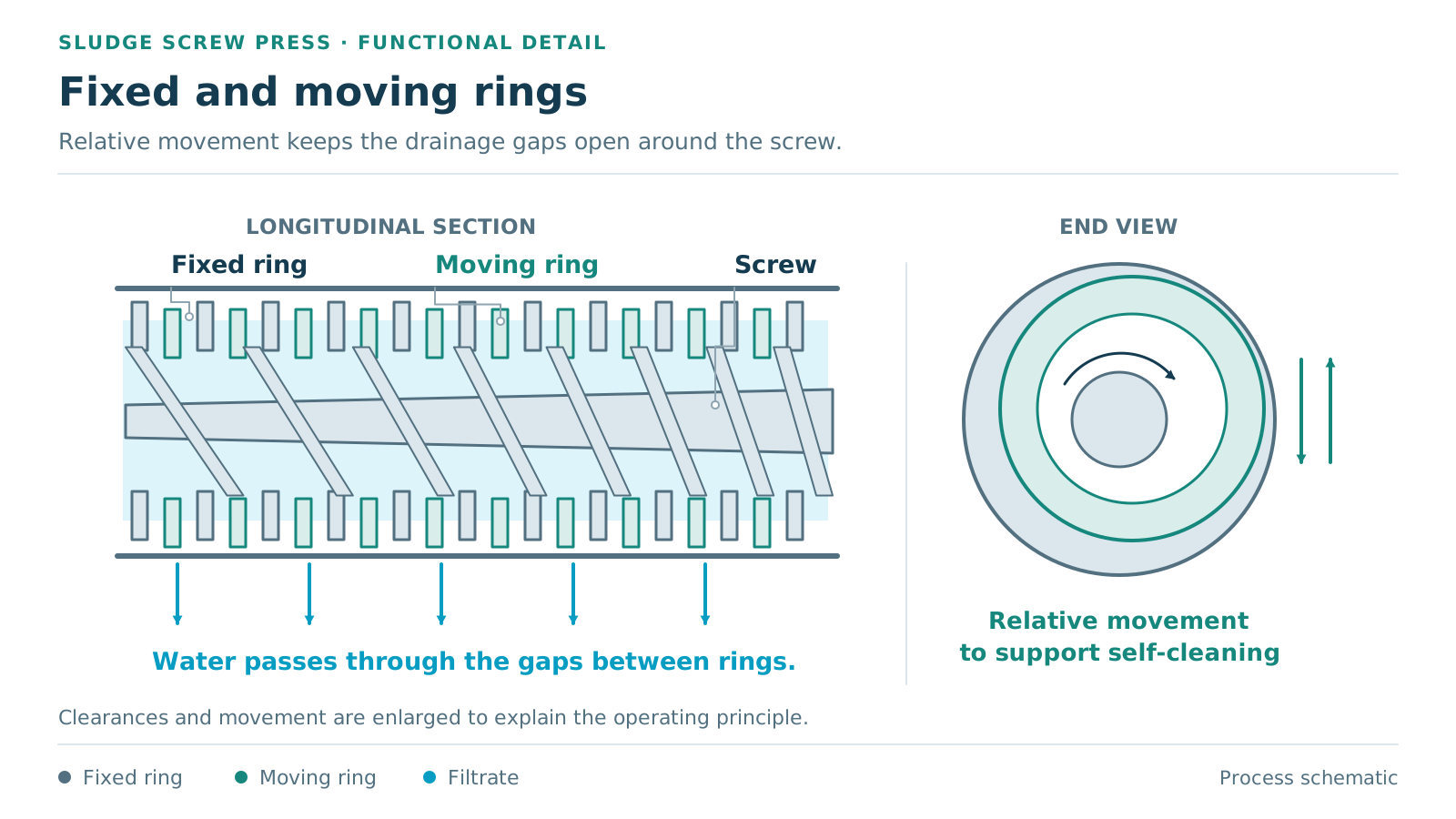
Moving rings follow screw rotation. Their relative movement helps dislodge deposits from the gaps as water drains through the cylinder.

Access to inspect thickening and dewatering along the cylinder.

Reference points for checking the condition of filtration elements.

Flocculation and drainage arrangement adapted to dilute sludge.

Biological and mixed sludge.

Organic residues and sludge.

Wastewater treatment sludge.
Compatible oily streams.
Sludge conditioned for drainage.

Industrial treatment sludge.
Fibres and treatment solids.

Selection based on chemistry and abrasion.
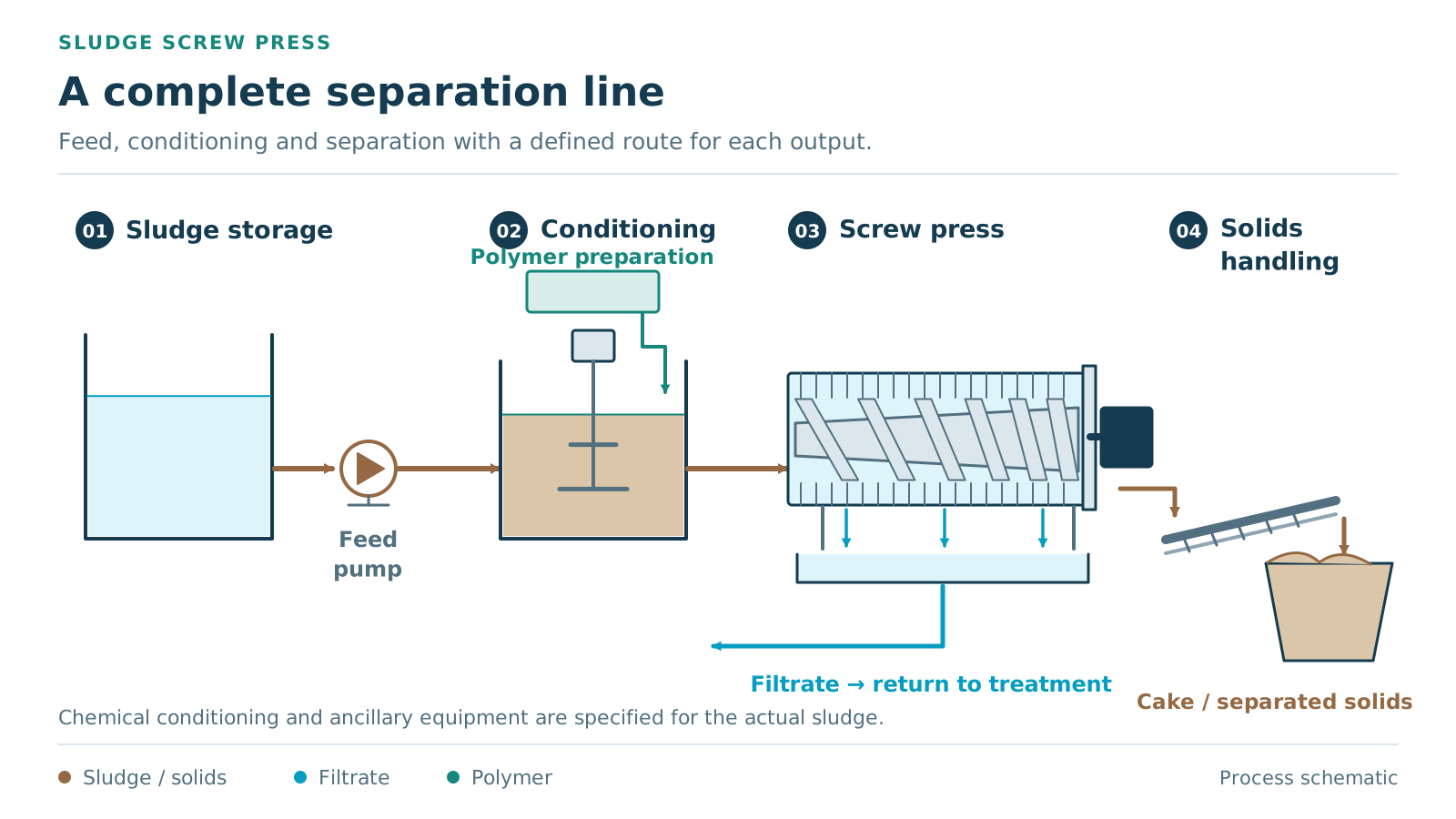
We select the feed pump, polymer preparation and dosing, washing, filtrate collection and cake handling. Connections and controls are specified for integration with your treatment plant.
| Configuration | kg DS/h low / high | 2 g/L | 4 g/L | 10 g/L | 20 g/L | 25 g/L | 50 g/L |
|---|---|---|---|---|---|---|---|
| 1 | 3 / 6 | 1.5 | 0.75 | 0.6 | 0.3 | 0.24 | 0.12 |
| 2 | 6 / 12 | 3 | 1.5 | 1.2 | 0.6 | 0.48 | 0.24 |
| 3 | 12 / 24 | 6 | 3 | 2.4 | 1.2 | 0.96 | 0.48 |
| 4 | 12 / 20 | 6 | 3 | 2 | 1 | 0.8 | 0.4 |
| 5 | 24 / 40 | 12 | 6 | 4 | 2 | 1.6 | 0.8 |
| 6 | 30 / 60 | 15 | 7.5 | 6 | 3 | 2.4 | 1.2 |
| 7 | 60 / 120 | 30 | 15 | 12 | 6 | 4.8 | 2.4 |
| 8 | 90 / 180 | 45 | 22.5 | 18 | 9 | 7.2 | 3.6 |
| 9 | 60 / 120 | 30 | 15 | 12 | 6 | 4.8 | 2.4 |
| 10 | 120 / 240 | 60 | 30 | 24 | 12 | 9.6 | 4.8 |
| 11 | 180 / 360 | 90 | 45 | 36 | 18 | 14.4 | 7.2 |
| 12 | 240 / 480 | 120 | 60 | 48 | 24 | 19.2 | 9.6 |
| 13 | 100 / 170 | 50 | 25 | 17 | 8.5 | 6.8 | 3.4 |
| 14 | 200 / 340 | 100 | 50 | 34 | 17 | 13.6 | 6.8 |
| 15 | 300 / 510 | 150 | 75 | 51 | 25.5 | 20.4 | 10.2 |
| 16 | 400 / 680 | 200 | 100 | 68 | 34 | 27.2 | 13.6 |
Flow rates in m³/h. Allowable dry-solids loading differs between low- and high-concentration duties; hydraulic and mechanical configuration are selected together.
| Configuration | L × W × H (mm) | Discharge (mm) | Empty / operating weight (kg) | Power (kW) | Wash water (L/h) |
|---|---|---|---|---|---|
| 1 | 1860 × 750 × 1080 | 215 | 205 / 295 | 0.2 | 24 |
| 2 | 1860 × 750 × 1080 | 250 | 205 / 300 | 0.2 | 24 |
| 3 | 1960 × 870 × 1080 | 250 | 275 / 425 | 0.3 | 48 |
| 4 | 2440 × 860 × 1380 | 350 | 320 / 470 | 0.3 | 32 |
| 5 | 2580 × 977 × 1270 | 350 | 470 / 730 | 0.6 | 64 |
| 6 | 3350 × 941 × 1564 | 495 | 910 / 1320 | 0.8 | 40 |
| 7 | 3570 × 1260 × 1670 | 495 | 1350 / 2130 | 1.2 | 80 |
| 8 | 3830 × 1620 × 1670 | 495 | 1820 / 2880 | 1.95 | 120 |
| 9 | 3900 × 1160 × 2190 | 585 | 1610 / 2210 | 1.9 | 72 |
| 10 | 4240 × 1550 × 2190 | 585 | 2300 / 3400 | 3.75 | 144 |
| 11 | 4460 × 2100 × 2190 | 585 | 3350 / 4850 | 6.0 | 216 |
| 12 | 4660 × 2650 × 2190 | 585 | 4500 / 6100 | 8.2 | 288 |
| 13 | 4356 × 1170 × 2400 | 759 | 2500 / 3400 | 2.25 | 80 |
| 14 | 4900 × 1640 × 2400 | 759 | 3480 / 5200 | 4.5 | 160 |
| 15 | 5030 × 2240 × 2400 | 759 | 4550 / 7050 | 6.7 | 240 |
| 16 | 5350 × 3240 × 2400 | 759 | 6550 / 9660 | 8.2 | 320 |
Reference data for equipment selection. Capacity, materials and utilities are confirmed for the project sludge and operating schedule.
Yes, this is a common candidate duty. Concentration, grease and conditioning response determine capacity, polymer demand and achievable dryness.
Dryness depends on sludge characteristics and operating settings. Selection follows composition, dewatering tests, dry-solids loading and the handling objective.
Tell us the sludge origin, daily volume, concentration and available operating hours.
We will review the application and explain the solution we can supply or the information needed to assess it.
Contactcomercial@neptunoes.comEmail water analyses, photographs and drawings to our sales address.