Condition
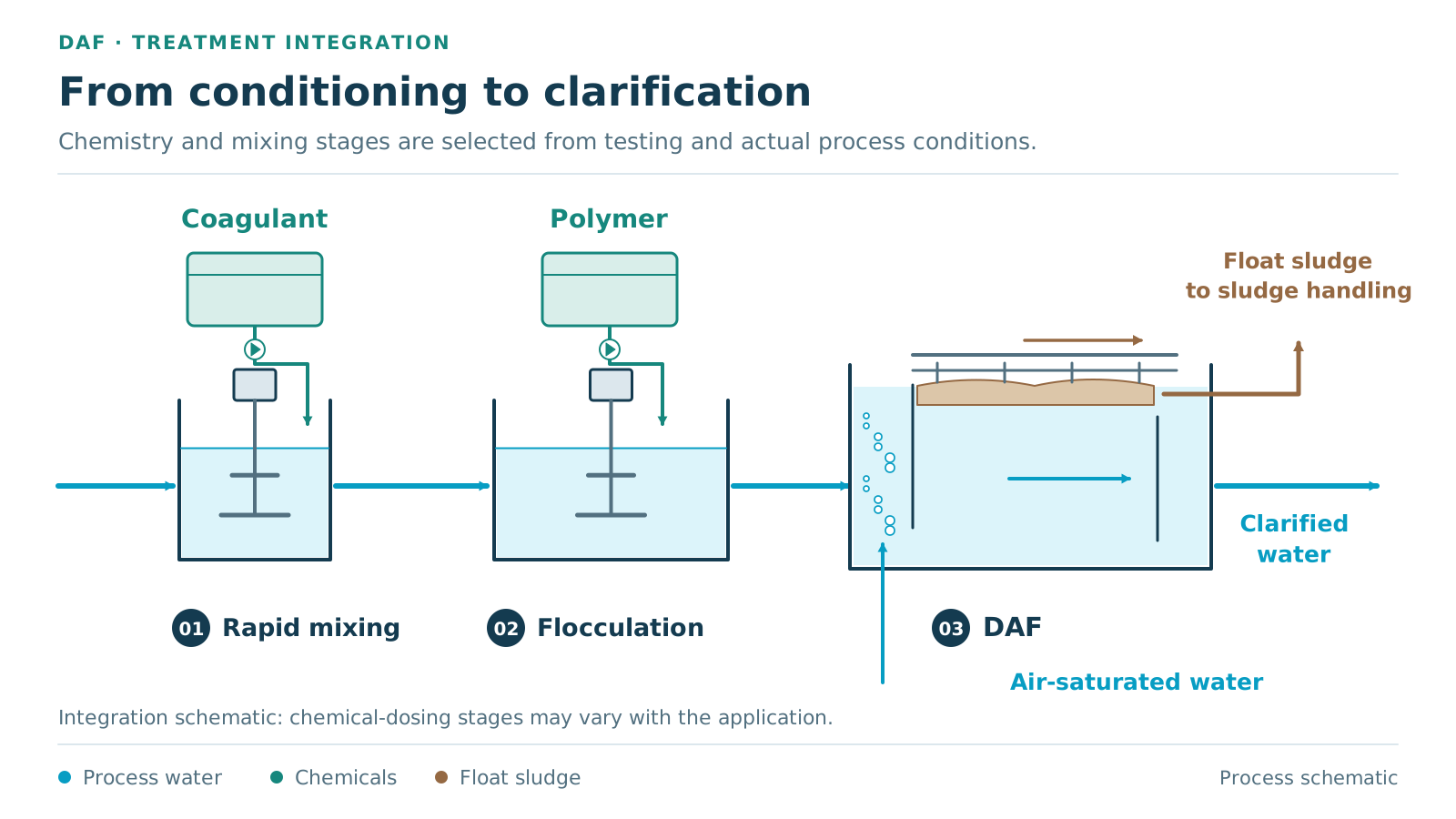
Mixing, coagulation and flocculation where feedwater requires them.


Dissolved air flotation to remove grease, flocs and suspended solids. A compact clarification stage that prepares water for what comes next.
Separate floatable load before it affects the rest of the plant.
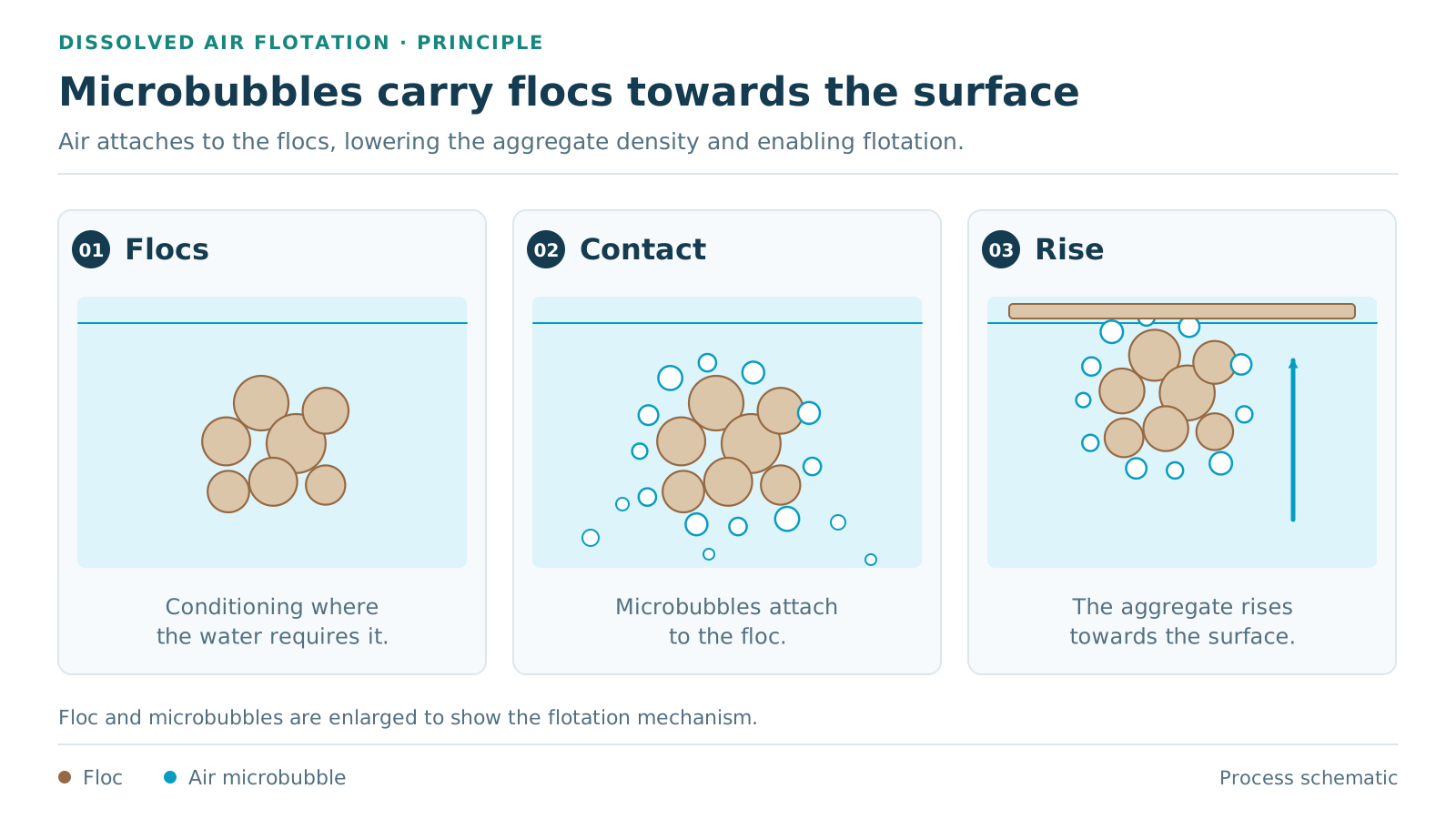
Microbubbles attach to particles and flocs, carrying them to the surface. A skimmer removes the float layer while clarified water continues through the treatment train. Chemical conditioning is matched to the separation your effluent requires.
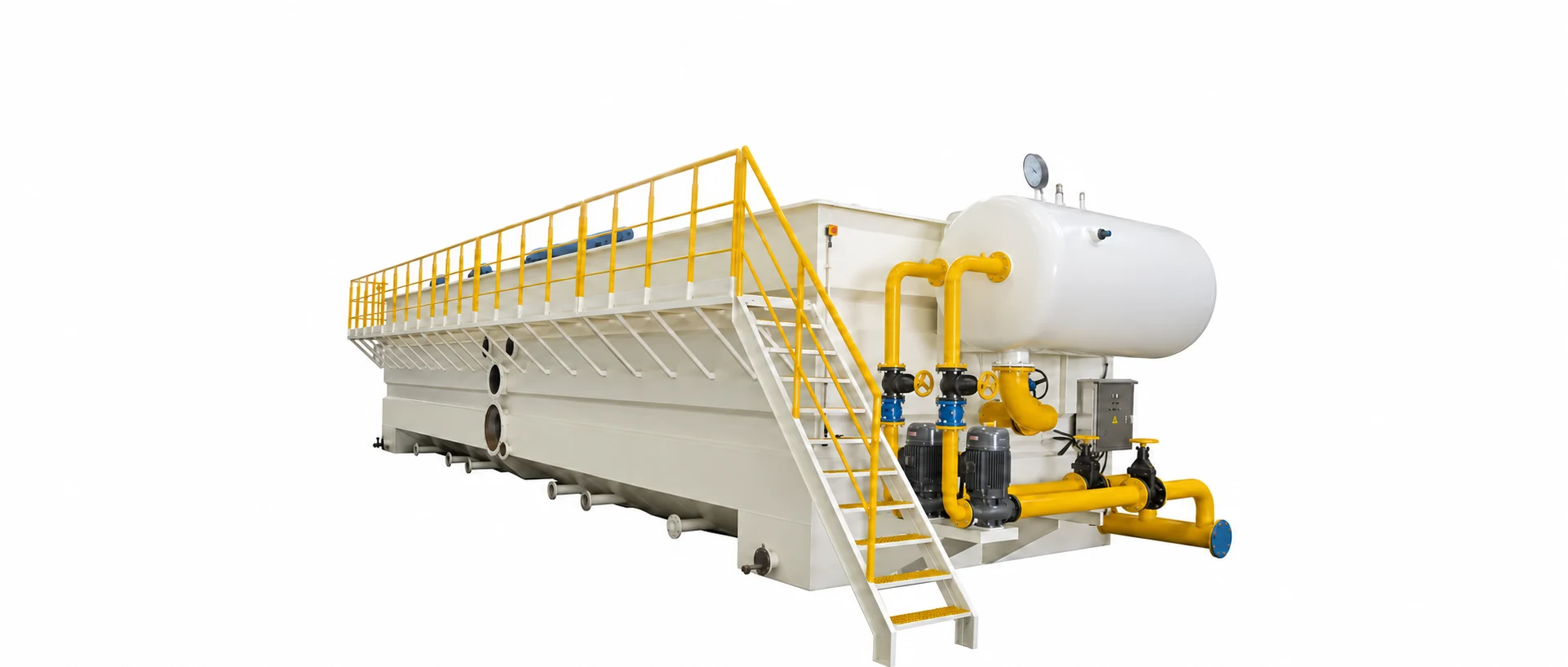
Mixing, coagulation and flocculation where feedwater requires them.
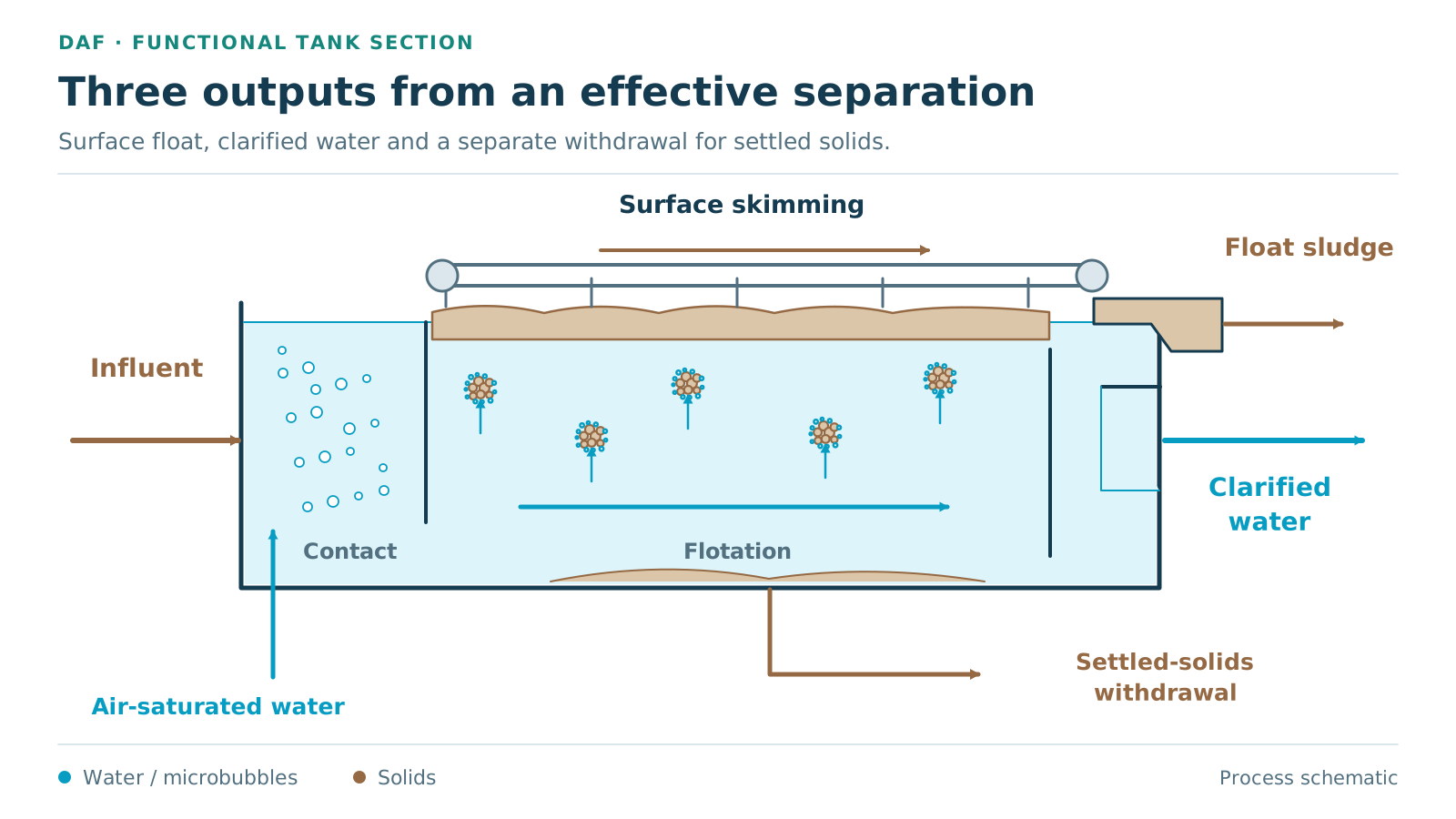
Contact between the effluent and pressurised water containing dissolved air.
Separate circuits remove surface float and settled solids.
Outlet quality depends on the effluent, solids loading, flocculation and hydraulic design. Recycle flow and air supply are selected together with the separation area.
Solids and grease reduction.
Separation of the floatable fraction.
Concentration through flotation.
Fibres and recoverable solids.

Water prepared for the next stage.

Support for treatment lines.
Pretreatment within a complete treatment train.

Particle and floc separation.
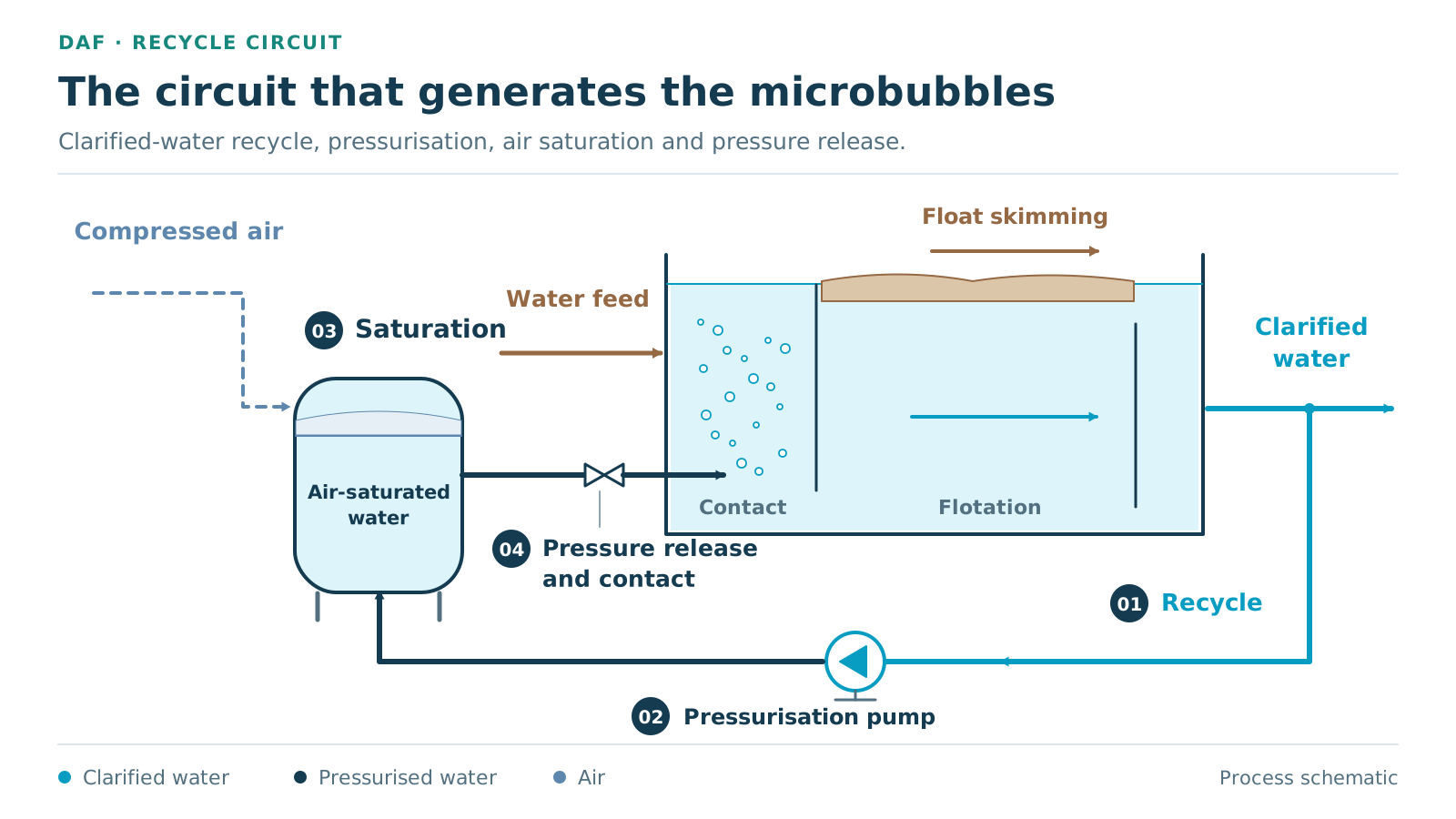
A recycle stream is contacted with air under pressure.
Pressure release generates bubbles in the effluent contact zone.
Clarified water, surface float and settled solids are routed to their destinations.
We combine DAF with chemical preparation, sludge storage and dewatering. A screw press can complete the train to reduce the volume removed from the plant.
Explore the screw press| Nominal capacity (t/h) | L × W × H (mm) | Empty / operating weight (t) | Installed / operating power (kW) |
|---|---|---|---|
| 1 | To confirm | 1.1 / 3.5 | 1.6 / 1.27 |
| 3 | 2350 × 1000 × 1600 | 3 / 8 | 4.75 / 4.42 |
| 5 | 2800 × 1000 × 2100 | 3 / 8 | 4.75 / 4.42 |
| 10 | 3200 × 1200 × 2200 | 4 / 12 | 4.75 / 4.42 |
| 25 | 5000 × 1500 × 1350 | 5.5 / 21 | 5.65 / 5.52 |
| 50 | 6500 × 2000 × 2500 | 7 / 36 | 8.5 / 7.65 |
| 80 | 7600 × 2600 × 2600 | 9 / 55 | 11.05 / 10.2 |
| 100 | 8300 × 3000 × 2600 | 12 / 70 | 16.2 / 14.9 |
| 150 | 10000 × 3600 × 2850 | 16 / 110 | 21 / 19.3 |
| 200 | 12800 × 3000 × 3000 | 26 / 160 | 25.9 / 23.5 |
For water close to 1 t/m³, values in t/h are approximately equivalent to m³/h. Dimensions of the smallest unit remain to be confirmed.
Reference data for equipment selection. Capacity, materials and utilities are confirmed for the project sludge and operating schedule.
Coagulation and flocculation depend on the particles and quality target. Treatability tests establish chemicals and doses before final design.
Yes, by removing the load that can be separated by flotation. We check the resulting quality against downstream requirements; DAF does not remove salts or all dissolved organic matter.
Tell us the flow, solids, fats and quality needed downstream.
We will review the application and explain the solution we can supply or the information needed to assess it.
Contactcomercial@neptunoes.comEmail water analyses, photographs and drawings to our sales address.